Tech
India’s Regional Navigation System NavIC Faces Operational Challenge After Latest Satellite Atomic Clock Failure: Report
Swarajya Staff
Mar 14, 2026, 04:10 PM | Updated 04:10 PM IST
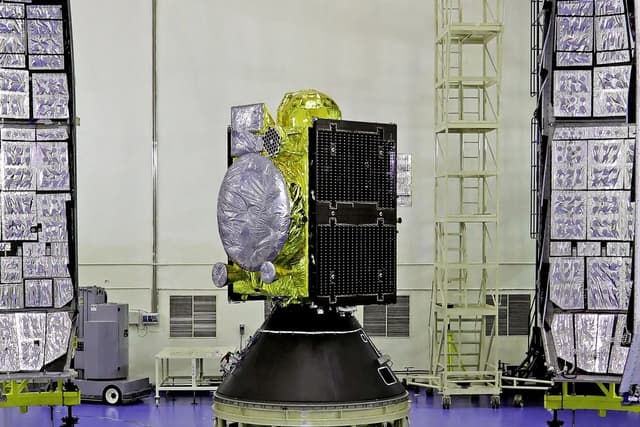
India's indigenous satellite navigation system NavIC has reportedly been rendered effectively defunct following the failure of a critical atomic clock on the IRNSS-1F satellite yesterday (13 March).
The Indian Space Research Organisation (ISRO) confirmed that the onboard atomic clock stopped functioning on 13 March 2026. This development leaves barely three of 11 NavIC satellites fulfilling their core positioning, navigation and timing services.
Theoretically, a bare minimum of four satellites is required for the functioning of NAVIC, Wion News reported.
The Navigation with Indian Constellation (NavIC) system, designed to provide positioning accuracy within India and 1,500 kilometres beyond its borders, now operates with just two first-generation satellites—IRNSS-1B and IRNSS-1I—both facing high risks of imminent failure.
IRNSS-1B has already exceeded its planned 10-year lifespan and is now in its 11th year of operation, while IRNSS-1I, launched in 2018, is expected to remain functional only until 2028.
The crisis deepens as India's second-generation replacement satellite, NVS-02, which failed to reach its designated orbit in January 2025 due to a propulsion system malfunction, remains stranded and unable to provide navigation services.
ISRO had launched NVS-01 in May 2023, and that satellite has been working as designed, as per the agency.
Of the eight first-generation satellites successfully placed in orbit between 2013 and 2018, five have suffered complete atomic clock failures, while IRNSS-1F had already lost two of its three atomic clocks before yesterday's final failure.
The government has stated in Parliament that three next-generation satellites—NVS-03, NVS-04, and NVS-05—are planned for launch by the end of 2026 to replenish the constellation.
However, ISRO has faced three mission failures in six launches executed between January 2025 and January 2026, raising serious doubts about the ambitious timeline.
NavIC, conceived after the United States denied India GPS access during the 1999 Kargil War, serves critical military applications including missile guidance and troop movements, as well as civilian uses in disaster management and commercial vehicle tracking.
 Join our