Uttar Pradesh
The Akhilesh Yadav That BJP Hasn't Met Yet
Abhishek Kumar
Feb 12, 2026, 02:51 PM | Updated Mar 04, 2026, 03:58 PM IST
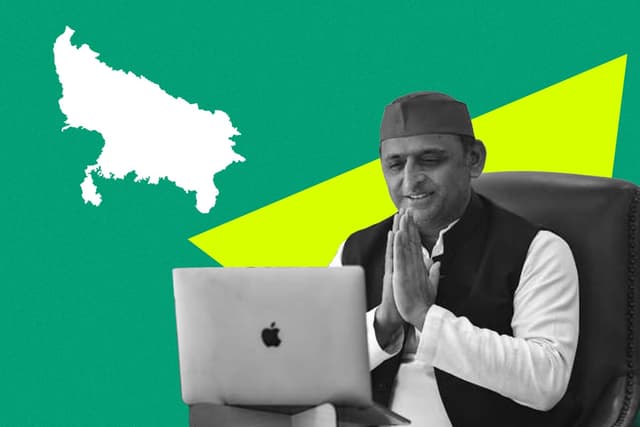
There is a tendency in Indian political commentary to treat opposition leaders as static objects, frozen in the posture of their last defeat. The BJP’s internal assessments of Akhilesh Yadav, if the party’s public rhetoric is any guide, still seem calibrated to the man who lost 2017 amid a family civil war and fell short in 2022 despite a spirited comeback.
That would be a serious miscalculation.
The Akhilesh Yadav approaching 2027 is a qualitatively different political operator, one who has shed old vulnerabilities, acquired new weapons, and is executing a multi-front disruption strategy that the BJP’s Uttar Pradesh unit has not yet demonstrated the capacity to counter.
The Backstory
In 2017, Yadav fought as the young incumbent projecting modernity — laptops, expressways, technocratic governance — but amid the most public family feud in modern Indian politics. The SP won just 47 seats on roughly 21.8 per cent vote share. The perception was of a chief minister who held power but never truly controlled it.
By 2022, the family baggage was resolved and the PDA (Pichda, Dalit, Alpsankhyak) framework had taken ideological shape. Vote share surged past 32 per cent; the SP won 111 seats. Yet it remained boxed into the Muslim-Yadav core. The baahubali tag clung to candidates, and Yadav lacked the X-factor to prise upper-caste voters away from the BJP’s social engineering.
Then came 2024, the inflection point the BJP underestimated. The INDI alliance won 43 of 80 UP Lok Sabha seats with 43.52 per cent of the popular vote. The SP alone took 37, up from five in 2019. What made the difference was how Yadav community tickets were cut substantially while Kurmi, Maurya, Kushwaha, and Pasi candidates were strategically fielded.
Senior leaders like Naresh Uttam Patel and Lalji Verma won comfortably. The Congress seat-sharing was clinically executed. OBC MPs outnumbered forward-caste MPs in the SP’s parliamentary delegation for the first time.
This was the election where Akhilesh Yadav proved he could beat the Modi-Yogi BJP. It was the proof-of-concept moment.
The Three Levers of Akhilesh 2027
The Silicon Valley Turn: When Akhilesh Yadav distributed laptops as chief minister, the BJP mocked it as populist gimmickry. A decade later, the technology pitch operates at an entirely different register.
In November 2025, the SP launched “Vision India” as a national programme. The first summit was held in Bengaluru; the second — the Vision India AI Summit — in Hyderabad on 13 December 2025, where Yadav addressed AI, cybercrime, and data privacy, demanding a comprehensive AI regulation bill in Parliament. He declared that the SP would use AI technology to defeat the BJP in 2027.
The rhetoric is surprisingly backed by operational infrastructure. Yadav has set up voter-assistance camps across the state during the ongoing Special Intensive Revision of electoral rolls, deploying “PDA Prahraris” — cadre tasked with protecting voter registrations and collecting evidence of irregularities.
With the clear intent of projecting the SP as an active watchdog over the electoral revision process, Yadav has been publishing granular SIR data on social media — highlighting the spike from zero Form 7 submissions between 6 and 8 January 2026 to a record 8,503 on 31 January alone, with over 57,000 total objection applications by month’s end.
Effectively, he turned SIR into a running data campaign.
The SP is using data as a weapon, tracking booth-level discrepancies, publishing numbers that force the Election Commission to respond, and creating a narrative of electoral vigilance that doubles as voter mobilisation.
At the Hyderabad event, Yadav also signalled expansion ambitions, describing former Telangana CM K. Chandrashekar Rao and his son K.T. Rama Rao as constant companions — a remark analysts read as a marker for potential southern Indian alliances.
The slogan — Jisse ho sabki bhalaai, wahi hai saccha AI — coined at the summit captures the duality of his pitch: folksy enough for a nukkad rally, sophisticated enough for a tech conference. That range is new.
The Prabuddhan Pivot: The most tactically significant shift is the systematic courtship of the Brahmin community, not as an afterthought but as a structured plank running parallel to PDA. The groundwork was laid before 2022 with Parshuram symbolism, Brahmin conclaves, and the Bhagwan Parshuram Trust.
After 2024, he appointed Mata Prasad Pandey, a seven-time Brahmin MLA with 45 years of experience, as Leader of the Opposition, placing a Brahmin face at the opposition bench without alienating the base. By mid-2025, the SP was raising pointed questions about alleged Thakur over-representation in police postings across districts like Mahoba, Prayagraj, and Mainpuri.
In June, when Yogi Adityanath unveiled a Maharaj Suheldev statue in Bahraich, Akhilesh Yadav promised a gold statue of the same ruler at Lucknow’s Gomti Riverfront. Maharaj Suheldev is today seen as icon of the Rajbhar community.
Then came the bati-chokha episode. On 23 December 2025, over 25 BJP Brahmin MLAs gathered at Kushinagar MLA P.N. Pathak’s Lucknow residence to discuss the community’s perceived neglect. BJP state president Pankaj Chaudhary warned against such “caste-based meetings.”
On New Year’s Day 2026, Akhilesh hosted a bati-chokha lunch at SP headquarters, simultaneously mocking the BJP’s internal discord, and extending a hand to disgruntled legislators.
The electoral arithmetic makes this hazardous for the BJP. Brahmins constitute roughly 13 per cent of UP’s population.
The Brahmin outreach capitalises on the Brahmin-Thakur tussle in eastern UP, where seats like Gorakhpur, Maharajganj, and Basti encompass 30 assembly segments with sizeable Brahmin populations. Even a modest drift would severely damage the BJP’s Purvanchal calculus.
Meanwhile, Akhilesh Yadav's positions on the UGC draft regulations and the NEP — joining the DMK protest against centralised faculty recruitment norms, calling the education policy an attempt to centralise control — are calibrated to resonate with the academic class without explicitly alienating the dominant forces.
Professional Ground Warfare
The third lever is the least visible but most consequential. Akhilesh Yadav is building a professional campaign infrastructure that prioritises winnability over the feudal instincts of ticket distribution. In 2024, the evidence was clear: Yadav tickets cut, non-Yadav OBC and Dalit candidates fielded on demographic basis, Congress accommodated as a strategic investment.
For 2027, the SP will likely contest within the INDI bloc and is using the panchayat elections expected in mid-2026 as a proving ground for booth-level machinery.
Crucially, Yadav has also shed the image of the Twitter politician.
His yatras, district interventions, and commentary on local issues — from Kaushambi to Aravalli — suggest a leader who understands that digital presence without a physical ground game is a formula for defeat.
What This Means for the BJP
None of this guarantees Akhilesh Yadav will form the next government. The BJP retains formidable advantages: organisational depth, incumbency machinery, central scheme deployment, and Narendra Modi’s presence. Yogi Adityanath’s brand of muscular governance commands a significant base.
But the stress fractures are visible. The bati-chokha episode revealed a Brahmin-versus-organisation fault line the state president had to address publicly. Keshav Prasad Maurya’s assertion of “neither Brahminism nor Thakurism, here it is only BJP-ism” is itself read as an admission of the looming question on top leadership.
The SIR process has become a potent weapon in the SP’s hands, with Akhilesh framing the removal of 2.89 crore voter names as vote theft and demanding Supreme Court intervention.
The man the BJP faces in 2027 is not the hobbled incumbent of 2017 or the limited challenger of 2022. He is now a battle-hardened operator who has beaten the BJP electorally, built a technology-and-data infrastructure no Indian opposition leader outside the TMC has attempted, opened a credible Brahmin front without diluting his OBC-Dalit-minority base, and demonstrated the discipline to subordinate dynasty instincts to professional winnability.
The BJP does not need to admire this evolution. It needs to recognise it, study it, and prepare a counter-strategy of commensurate sophistication, because the worst thing the ruling party can do is walk into 2027 fighting the ghost of an opponent who no longer exists.
Abhishek is Staff Writer at Swarajya.
 Join our