Uttar Pradesh
Yogi Adityanath Has Resisted Cash Transfers Till Now. Can He Hold The Line Until 2027?
Swarajya Staff
Feb 13, 2026, 10:14 AM | Updated Mar 04, 2026, 03:57 PM IST
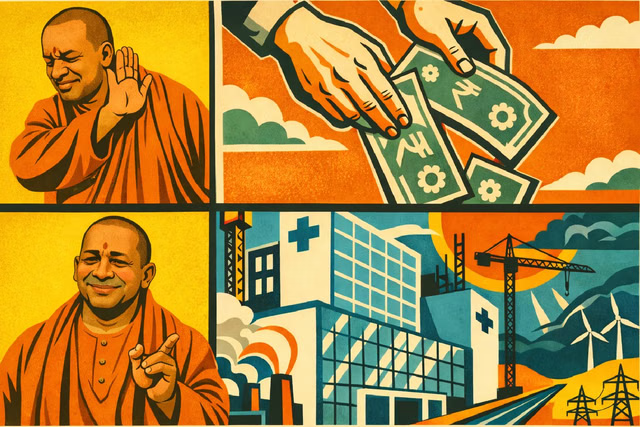
Neither the Uttar Pradesh Economic Survey, released on 9 February, nor the state Budget, presented 11 February, introduced a cash transfer scheme like the Ladki Bahin scheme in Maharashtra or the Ladli Behna scheme of Madhya Pradesh.
This decision of the state government to resist the temptation of a politically rewarding scheme deserves praise and is undoubtedly against the tide of political compulsions. The question is, how long can Yogi Adityanath resist the tide?
Across India, unconditional cash transfers (UCTs) to women have become the defining welfare innovation (or fiscal hazard) of the 2020s. According to PRS Legislative Research, 12 states will collectively spend Rs 1.68 lakh crore on such schemes in FY 2025-26. That is up from just two states three years ago.
Estimates suggest that these programmes now reach 11.8 crore adult women, roughly one-fifth of India's adult female population. What began as a tentative experiment in Goa in 2013 (the Griha Aadhar scheme) has become a political juggernaut that no party contesting a state election dares ignore.
Uttar Pradesh, with 24.1 crore people and approximately 11.6 crore women, is conspicuously absent from this list. This is not an oversight. It is a policy choice, and one that deserves cautious, qualified praise. The incentives to introduce such a scheme in UP are growing stronger by the day.
The national landscape: a race without a finish line
The proliferation of women-targeted UCTs across Indian states follows a strikingly uniform template. A state government, typically ahead of an election, announces a monthly cash transfer of Rs 1,000 to Rs 2,500 to women between 18-21 and 60-65, subject to a family income ceiling (usually Rs 2-2.5 lakh per annum). The money arrives via DBT into bank accounts. No conditions are attached: no requirement to send children to school, complete vaccinations, attend skill training, or demonstrate any behavioural change. The political returns are immediate and measurable; the fiscal consequences are deferred.
The numbers are staggering. Madhya Pradesh's Ladli Behna Yojana, launched in June 2023 just months before assembly elections, now reaches 1.27 crore women at Rs 1,500 per month. The state budgeted Rs 18,669 crore for the scheme for 2025-26 and then raised it to Rs 20,451 crore after hiking the monthly amount from Rs 1,250 to Rs 1,500. The BJP's 2023 election manifesto promises a further increase to Rs 3,000 by 2028. Madhya Pradesh's fiscal deficit for 2025-26 is projected at 4.7 per cent of GSDP, well above the FRBM norm of 3 per cent.
Maharashtra's Mukhyamantri Majhi Ladki Bahin Yojana, launched in July 2024 ahead of assembly elections, reaches 2.53 crore women at Rs 1,500 per month. The allocation for 2025-26 is Rs 36,000 crore, reduced from Rs 46,000 crore the previous year, with the promised increase to Rs 2,100 quietly shelved. Maharashtra now carries a revenue deficit of Rs 45,892 crore and total debt projected at Rs 9.3 lakh crore, the highest in state history.
Karnataka's Gruha Lakshmi provides Rs 2,000 per month to women listed as heads of household on ration cards (covering Antyodaya, BPL, and APL categories, excluding taxpayers), reaching over 1.33 crore beneficiaries, with Rs 28,608 crore allocated.
West Bengal's Lakshmi Bhandar reaches crores of women at Rs 500-1,000 per month, with an allocation of Rs 26,700 crore in 2025-26, consuming over 10 per cent of the state's revenue.
Tamil Nadu's Kalaignar Magalir Urimai Thogai Thittam provides Rs 1,000 per month, targeting over 1 crore women.
Delhi's BJP government approved the Mahila Samriddhi Yojana on International Women's Day (8 March 2025) at Rs 2,500 per month with a Rs 5,100 crore allocation.
Haryana launched the Deen Dayal Lado Lakshmi Yojana in September 2025 at Rs 2,100 per month for women with family income below Rs 1 lakh.
Jharkhand's Maiyan Samman Yojana pays Rs 2,500 per month. Odisha's Subhadra Yojana, structured differently as Rs 50,000 over five years (two annual instalments of Rs 5,000 each, disbursed on Raksha Bandhan and International Women's Day), has enrolled over 1 crore women, an estimated 71 per cent of the state's adult female voters.
Beyond the monthly UCT states, other states have adopted lump-sum variants. In Bihar, the NDA transferred a one-time Rs 10,000 each to women under the Mukhyamantri Mahila Rojgar Yojana: to 75 lakh women in the first tranche launched by PM Modi on 26 September 2025, expanding to over 1 crore by election day in November. The NDA won 202 of 243 seats.
Six of the 12 states implementing UCTs have projected a revenue deficit for 2025-26. PRS notes that if UCT expenditure were excluded, the fiscal indicators of these states would improve materially. Karnataka, for instance, would swing from a revenue deficit of 0.6 per cent of GSDP to a surplus of 0.3 per cent.
The political logic is transparent. These schemes are timed to elections, targeted at the fastest-growing voter constituency (women), and designed to be visible and attributable. They work. The BJP credited Ladli Behna for its 163-seat haul in Madhya Pradesh in 2023. Maharashtra's Mahayuti coalition attributed much of its November 2024 landslide to Ladki Bahin. No party that has launched such a scheme has been willing to withdraw it.
What Uttar Pradesh does instead
The UP Economic Survey 2025-26 and Budget reveal a welfare architecture that is almost entirely conditional or in-kind. The major transfer programmes operating in the state can be grouped as follows.
The single largest cash transfer is PM-KISAN, a central scheme, not a state initiative. From 2018-19 to November 2025, close to Rs 94,668.58 crore was transferred via DBT to 3.42 crore farmers across 21 instalments. This is Rs 6,000 per year per farmer household, unconditional in practice but framed as agricultural support, not women's welfare.
The Mukhyamantri Kanya Sumangala Yojana has benefited 26.81 lakh girls as of January 2026. This is a conditional transfer: payments are tied to specific milestones in a girl child's life, including birth, completion of vaccinations, school enrolment at various stages, and graduation. The total payout per beneficiary over the full lifecycle is modest, but the conditionality makes it a human capital investment, not a consumption subsidy.
The One District One Product (ODOP) scheme has disbursed Rs 890.44 crore in margin money since 2018-19, creating 3.22 lakh jobs. This is enterprise support, not welfare.
On health, 5.46 crore Ayushman Bharat cards have been issued, the highest in the country, providing insurance-based coverage rather than cash.
The pattern is clear. UP's welfare architecture channels resources through conditions (education, health milestones, enterprise creation, insurance) rather than through unconditional monthly deposits into women's bank accounts.
Why the restraint deserves cautious praise
The case for praising this restraint must be made carefully, because the incentive to abandon it is too strong.
Think back to early and mid-2024, the months immediately preceding the Lok Sabha elections. Rahul Gandhi of the Congress was going around India saying that once elected to power, he would ensure that direct cash transfers of up to Rs 8,500 reach beneficiary women's accounts khata khat (swiftly). In contrast, PM Narendra Modi and the BJP did not propose any such pan-India cash handout scheme.
When the results of the Lok Sabha polls were out, the BJP received a setback. It lost the simple majority of the House, falling from 303 seats to 240. The harshest blow came in Uttar Pradesh, where the party fell from 62 seats to 33.
Among other reasons, the reluctance of the BJP to propose an all-India unconditional cash transfer scheme was cited as one of the reasons for the party's less-than-expected performance.
Now, in February 2026, elections to the Uttar Pradesh Vidhan Sabha are around 12 months away. The evidence on whether the BJP has regained the support it lost during the Lok Sabha elections is present but is not beyond reasonable doubt.
That is why it would not be surprising if Yogi Adityanath gives in and the announcement of an unconditional cash transfer scheme is made anytime between now and October-November.
The cost of a "Ladli Behna-like" scheme for Uttar Pradesh
Uttar Pradesh's per capita income (net state domestic product per person) is Rs 1,09,844 in 2024-25, roughly half the national average. It can be argued that if any state's women need cash support, it is arguably UP's.
Yet the fiscal arithmetic of an unconditional transfer at UP's scale could be devastating. Consider the numbers. UP has approximately 11.6 crore women, of whom roughly 5-6 crore would fall in the 21-60 age bracket with family income below Rs 2.5 lakh (applying the eligibility criteria used by other states). Even a modest transfer of Rs 1,000 per month to 5 crore women would cost Rs 60,000 crore per year, equivalent to roughly 65 per cent of the state's entire fiscal deficit of Rs 91,400 crore, or 29 per cent of its own tax revenue of Rs 2.09 lakh crore.
At Rs 1,500 per month (the Ladki Bahin/Ladli Behna rate), the bill rises to Rs 90,000 crore, nearly the state's entire fiscal deficit, and more than the Rs 79,516 crore revenue surplus that currently gives UP its fiscal room for capital expenditure. The state would have to choose between paying women and building expressways. It could not do both.
This is not an abstract concern. UP's revenue surplus of 2.6 per cent of GSDP is its most valuable fiscal asset. It means the state collects more in revenue than it spends on revenue account, leaving borrowings available exclusively for capital expenditure: the expressways, industrial corridors, airports, and IMLC clusters that the state is betting on for long-term growth. An unconditional cash transfer on the scale that other states have adopted would consume this surplus entirely, forcing the state to borrow for consumption rather than investment.
Madhya Pradesh, which is comparable to UP in per-capita income, is running a fiscal deficit of 4.7 per cent of GSDP, well beyond FRBM norms, in significant part because of Ladli Behna. Its revenue surplus is a razor-thin 0.04 per cent of GSDP. MP has far fewer people than UP (8.4 crore versus 24.1 crore); even so, the scheme is straining its finances. Scale the same scheme to UP's population and the fiscal difficulty becomes self-evident.
The 2027 question
The opposition, whether the Samajwadi Party, the BSP, or the Congress, will almost certainly promise an unconditional cash transfer scheme for women. The BJP, having pioneered Ladli Behna in MP and endorsed Ladki Bahin in Maharashtra, will find it difficult to argue on principle against such schemes. The party's national template already includes them.
A conditional alternative: what would work for UP?
Given UP's specific economic realities (a young, poor, underskilled population with a massive demographic window that is closing), the most productive use of a new women-targeted transfer would be one that ties cash to human capital formation, not consumption.
Consider a scheme structured as follows.
A Mukhyamantri Mahila Kaushal Yojana (or similar name) that provides Rs 1,000-1,500 per month to women aged 18-45 who are enrolled in and attending certified skill training programmes, completing vocational courses, or running micro-enterprises registered under ODOP or the state's MSME framework.
The conditionality would be simple and verifiable: a woman enrolled in a training course at one of UP's training centres receives the stipend for the duration of training plus six months post-completion (to cover the transition to employment). A woman who starts a micro-enterprise and keeps it running for 12 months receives the transfer for that period.
This would cost far less than a universal UCT because the eligible pool is smaller, perhaps 50-80 lakh women at any given time, rather than 5-6 crore. At Rs 1,500 per month for 60 lakh women, the annual cost is Rs 10,800 crore, roughly 5 per cent of the state's own tax revenue, well within fiscal capacity, and comparable to what the state already spends on scholarships and skill programmes.
Because such a transfer is tied to a programme with a defined entry and exit, it does not create a permanent, expanding entitlement.
The scheme could be supplemented with a smaller, genuinely unconditional component: perhaps Rs 500 per month for all women over 60 in BPL households, as a de facto pension. At approximately 80-90 lakh beneficiaries, this would cost Rs 4,800-5,400 crore per year, bringing the total package to roughly Rs 15,000-16,000 crore, meaningful, visible, electorally potent, politically attributable, and fiscally sustainable at under 8 per cent of own tax revenue.
The window for getting this right is narrow. It closes sometime in late 2026, when electors start thinking about their choices for "Elections 2027".
The fate of the UP government and indeed of the BJP might be determined by what Yogi Adityanath decides between now and then.
 Join our