West Bengal
Mamata's Messy Bengal: How The Messi Fiasco Exposed The State's Deeper Governance Crisis
Samridh Joshi
Dec 17, 2025, 02:08 PM | Updated 02:08 PM IST
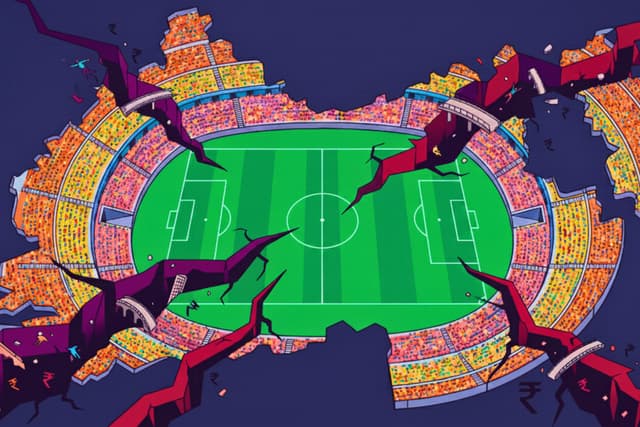
Saturday, 13 December, the Salt Lake Stadium in Kolkata was filled to the brim with football fans of all ages, all aiming to catch a glimpse of the famed football player Lionel Messi.
The tour of Messi, often hailed as the G.O.A.T (Greatest Of All Times) footballer and the architect of Argentina’s famous World Cup win, was a once-in-a-lifetime opportunity for millions of football fans across the state, which has been a hub of the sport in India since the 1800s.
However, the joy and excitement of the attending fans were short-lived, and the event soon descended into chaos. Most fans could not even spot Messi at the event, and those who were lucky enough got only a cursory glance at their hero.
As the event concluded, angry fans descended on the stadium, tearing through the arrangements and paraphernalia. Tickets worth tens of thousands of rupees went down the drain, and the general populace of West Bengal once again faced chaos all around.
The state today is in a similar state politically, socially, and economically, courtesy the ruling dispensation and politicians who simply do not care.
Netas Take the Cake: How the Messi Event Became a Mess
It is often that the public faces inconvenience due to the famed VIP culture in India. Kolkata, and leaders of the Trinamool Congress, took it to an entirely different level.
As the star arrived, more than 100 individuals, including politicians, officials, celebrities, and security staff, surrounded him, obstructing visibility for everyone else gathered in the stadium. This made the star visibly uncomfortable, and security reconsidered his plans. Prominent among the politicians surrounding him were the WB Sports Minister Aroop Biswas and MoS Sujit Bose.
The entourage of politicians and family members with privileged access were busy surrounding the star and clicking selfies, whilst poor people were left thirsty for a glimpse. Ministers from the TMC were repeatedly seen clutching the star and posing with him for multiple clicks.
The accompanying arrangements were no better, with poor-quality food being served at highly inflated prices at the event, and humble Rs. 20 water bottles being priced at a premium of Rs. 200 each.
The stadium also saw rowdy elements breaking gates and forcibly entering the venue without tickets, to the absolute horror of people who had spent, on average, Rs. 12,000 to witness the event. Contrast this with Hyderabad or Mumbai, where the same event had a much smoother organisation and outcome.
To add to the fiasco, the WB Government arrested the organiser, Satadru Dutta, possibly attempting to scapegoat him for a mess that had political origins.
This apathy is neither new nor isolated. The state faces similar chaos on the fronts of the economy, law and order, and political discourse.
Financial Meltdown and Economic Chaos
The state of West Bengal is in similar economic chaos, putting the development of the state and the livelihoods of its residents in peril. West Bengal’s share in India’s GDP has declined from 10.5% in FY 1960–1961 to merely 5.6% in FY 2023–24.
The state’s nominal GSDP growth rate is one of the lowest among major state economies. West Bengal’s Debt/GSDP ratio stands at 38.9%, a figure far exceeding FRBM mandates and one of the most troublesome in India.
The state also runs a revenue deficit, being unable to sustainably finance its own basic activities relating to the workforce and the population. The fiscal deficit is also high at 4.02%, breaking all norms suggested for debt sustainability.
West Bengal was also placed poorly in NITI Aayog’s fiscal health index, ranking third from last in India. The state scored the worst on debt sustainability and the second worst on debt mobilisation.
The industrial situation of the state fares no better. As per the Ministry of Corporate Affairs, 6,600 companies, including 110 listed companies, shifted their base out of West Bengal between 2011 and 2025.
People face poverty as the per capita income of the state lags behind the national average. Fifty-eight per cent of the state’s revenue expenditure is committed towards bare essentials such as salaries and pensions, leaving little room for investment.
Collapsing Infrastructure
The share of physical infrastructure spending as a proportion of total expenditure declined from an already low 5.27% in 2018–19 to 2.95% in 2022–23.
Incidents such as the Ultadanga Flyover collapse in 2013, an under-construction bridge at Girish Park in 2016, the Vivekananda Flyover collapse in Posta on 31 March 2016 killing 26 people, and the Majerhat Bridge collapse in 2018 causing casualties and injuries tell a sorry tale of the quality of infrastructure in the state.
These and similar incidents have been attributed to negligence by the government in maintenance and repairs, along with corruption and bribery involving contractors that led to poor-quality construction.
The heritage tram system of the state has been shut down due to losses and mismanagement. Among states, West Bengal has the lowest rural tap water connections, standing at a mere 54%.
Groundwater as well as rainwater in the western Bengal basin were found to have high concentrations of pesticides and toxic polycyclic aromatic hydrocarbons (PAH). As per Swach Sarvekshan 2023, all of the top ten dirty cities were found to be in the state of West Bengal.
NFHS-5 data also shows an alarming situation in terms of health and social infrastructure.
Lawlessness and No Order
The present dispensation has become a worthy successor to the terrorising regime of the erstwhile Communists. The state grapples with the culture of 'Syndicates' and 'Cut Money', which are other forms of organised illegal extortion rackets.
As per a report by the Indian Express, cut money rates can go as high as Rs. 25,000. Communal riots have surged, with the latest ghastly incidents taking place in Murshidabad.
Political violence has seen an ugly upsurge in the state of late. Nearly forty people were killed in the run-up to the 2023 panchayat polls in the state. West Bengal tops the list of states where politics is a cause of murder.
Incidents like the RG Kar rape and murder also raise several important questions.
A recent episode is a stark reminder of the horrors of the state. The car carrying one of the prime CBI witnesses of the Sandeshkhali riots, who was supposed to testify against the ruling TMC’s accused leader in the area, was hit by a lorry, in which the witness suffered injuries and his son was fatally wounded.
The lorry was reportedly being driven by an aide of the TMC leader Shahjahan Sheikh, and the witness blamed the incident on a plot by the accused. This episode, whilst looking straight out of a movie scene, speaks to the horrific realities of the state.
Light at the End of the Tunnel?
A visitor to the state is often wary of what fate may befall his life and liberty. The state police readily arrest anyone writing against the state government, as evident from a recent incident in which a popular Twitter user was reportedly arrested for speaking up against the Messi fiasco.
Free speech appears to be a myth in the state, and residents remain in constant fear, especially in political matters.
As the state gears up for the SIR findings, one wonders whether more violence will emerge. Unless the Centre monitors the situation to the best of its capacities, and the ECI, combined with the paramilitary forces, ensures a free and fair election, any light at the end of the tunnel is probably another train coming towards the residents of West Bengal.
Samridh Joshi is a Senior Economist and Policy Consultant at NFPRC. He is an alumnus of IIT Kanpur and UC3M Madrid. Views are personal.
 Join our