World
The Liberal Order Is Dying. The 'Mother Of All Deals', Trump's Vandalism, And West's Confession Prove It.
Anmol N Jain
Jan 27, 2026, 07:07 AM | Updated Feb 03, 2026, 10:51 AM IST
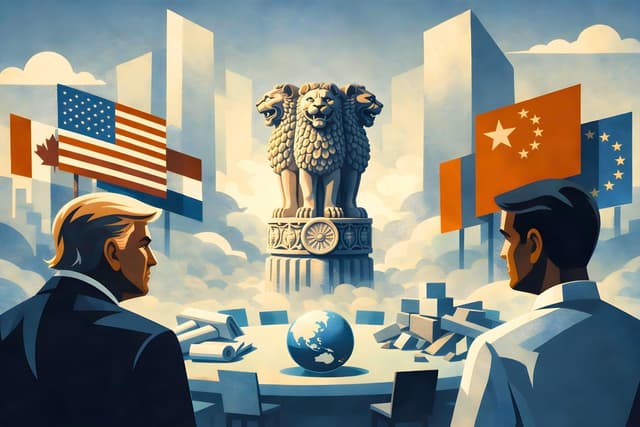
On 20 January 2026, Canadian Prime Minister Mark Carney stood before the assembled elite at Davos and delivered a speech that amounted to a confession.
"We knew the story of the international rules-based order was partially false," he said. "That the strongest would exempt themselves when convenient. That trade rules were enforced asymmetrically. And that international law applied with varying rigour depending on the identity of the accused or the victim."
The West, Carney admitted, had "lived within the lie" of the "rules-based order". A "useful fiction".
At the same Davos forum where Carney confessed, von der Leyen announced that the EU was "on the cusp" of what she called "the mother of all deals" with India. A Free Trade Agreement that India and the EU have been negotiating since 2007.
As India celebrated its Republic Day, two European Union leaders sat as chief guests at Kartavya Path: European Council President António Costa and European Commission President Ursula von der Leyen.
The timing is important here. The West is not merely admitting the lie. It is scrambling to hedge against its own architect's demolition.
A Western leader has confessed to the lie, Europe is pivoting toward the country it had long lectured, just as the American president continues to demolish the order he believes failed his country.
Carney's confession came exactly one year after Donald Trump's second inauguration, and thirteen days after Trump signed a memorandum withdrawing the US from 66 international organisations, declaring them "contrary to American interests".
For India, these events are not disconnected. They converge towards the same collapse. And the same opening.
For decades, the Global South argued precisely what Carney admitted: that the post-1945 order was a Western fiction. Rules for thee, exemptions for me. But India and others who made this argument were dismissed as resentful, revisionist, ungrateful. At Davos 2026 came the vindication.
Trump is not dismantling this order for India's benefit. He is doing it for America First, for MAGA, for his own grievances against institutions he believes have failed the United States. But the architecture he is demolishing is the same architecture that excluded India since 1945. India could not reform these institutions from within. Trump is demolishing them from above.
The unintended beneficiary of his vandalism may not be America alone.
The Order That Excluded India
To understand why Trump's destruction matters for India, consider the subject of this destruction. A system India has been trapped in for decades. It was structural, pervasive, and deliberate.
The Security Council's permanent membership reflects 1945's victors, not twenty-first century reality. India sought a permanent seat; China blocked it. India applied to the Nuclear Suppliers Group despite meeting every technical criterion; China blocked that too. Forty-seven of forty-eight member countries supported India's entry. The structural barrier is Article 108 of the UN Charter, which requires all five permanent members to ratify any amendment. Institutions built to freeze power cannot be persuaded to redistribute it.
But the exclusion was not limited to the UN Security Council.
The Bretton Woods institutions encoded Western supremacy into an unwritten "gentleman's agreement": the World Bank president is always an American, the IMF Managing Director always a European. Eighty years without exception. Fourteen American World Bank presidents. Twelve European IMF chiefs. France alone has held the IMF position for thirty-five of those years.
The Nuclear Non-Proliferation Treaty froze the 1967 order in perpetuity, explicitly discriminating between nuclear "haves" and "have-nots". India called it "nuclear apartheid" and refused to sign. For this, it faced decades of sanctions and technology denial, while signatories selectively ignored proliferation by allies.
The World Trade Organization's dispute resolution system was designed by and for developed nations. Agricultural subsidies that sustained Western farmers were protected; developing country protections were attacked as distortions. When the system stopped serving American interests, Washington paralysed it by blocking appellate body appointments.
The climate regime measured progress by metrics that suited the industrialised West: absolute emissions, not per capita; current output, not historical responsibility. It demanded sacrifice from nations that had contributed least while the largest historical emitters set the terms. Traditional practices that had sustained civilisations for millennia were dismissed as primitive rather than acknowledged as sustainable.
The human rights framework was selectively invoked. Saudi Arabia faced no consequences for Yemen. Israel faced no consequences for Gaza. But India was lectured on Kashmir, on citizenship laws, on press freedom. International law, as Carney confessed, "applied with varying rigour depending on the identity of the accused or the victim".
What was referred to as rules-based order was actually a power-based order with rules as camouflage.
The Great Dismantling
Donald Trump has no interest in reforming these institutions. He finds them unfit for purpose and unfair to their chief architect, the US.
The withdrawal cascade began on his first day of his second term. On 20 January 2025, he signed Executive Order 14155 withdrawing the United States from the World Health Organization. The Paris Climate Agreement followed hours later. Then came withdrawal from the UN Framework Convention on Climate Change itself, making the US the first country ever to abandon the foundational 1992 climate treaty.
Then came the exit from the UN Human Rights Council. UNESCO followed in July. The International Criminal Court faced economic assault: nine ICC personnel were sanctioned, including the Chief Prosecutor and six judges. The WTO's dispute resolution system, already paralysed since 2019, became formally non-functional.
Then in 2026 came the 7 January memorandum: sixty-six organisations in one stroke.
Secretary of State Marco Rubio articulated the doctrine. These institutions, he declared, are "redundant in scope, mismanaged, unnecessary, wasteful, poorly run, captured by interests advancing agendas contrary to our own, or a threat to our sovereignty".
The 2025 National Security Strategy made this shift explicit. The document repudiates what it calls the post-Cold War mistake of American elites who "lashed American policy to a network of international institutions". It declares that "the world's fundamental political unit is and will remain the nation-state".
This is not merely policy adjustment. It is ideological repudiation. Since 1945, liberal internationalism assumed that sovereignty would gradually dissolve, that nations would cede authority to supranational institutions, international courts, multilateral frameworks. The nation-state was a transitional form to be transcended. The European Union was the apotheosis of this vision.
The 2025 National Security Strategy rejects this trajectory. The nation-state is not a phase to be overcome. It is the permanent unit of global politics. For India, which never accepted the post-Westphalian erosion of sovereignty that Europe embraced, this is vindication.
The hegemon is not walking away from power. It is shedding the pretence of multilateral legitimacy. The US does not have to be a benevolent hegemon when it can simply be a hegemon.
Civilisational Realism: A New Framework
The National Security Strategy describes the world not through the Cold War binary of democracy versus autocracy, nor through the post-Cold War framework of liberal internationalism, but through what can be called "Civilisational Realism".
The world, in this framework, consists of distinct civilisations that must coexist through balance of power rather than converge toward a single liberal model. The United States should focus on its sphere, the Western Hemisphere under a revived Monroe Doctrine now formally termed the "Trump Corollary", while other great powers manage their own regions.
This represents a fundamental break from seven decades of American foreign policy consensus. Since 1945, the animating assumption of US grand strategy was that the liberal model would eventually triumph everywhere. It was this misjudgement that the US made while aiding China's economic rise, thinking it would eventually embrace liberal democracy.
Now, under Civilisational Realism, such assumptions are abandoned.
For India, this represents liberation from decades of condescension.
For years, US-India relations were complicated by American critiques of human rights, press freedom, religious pluralism, and democratic backsliding. Washington, along with its Western partners, lectured Delhi on values while exempting its own allies from similar scrutiny. But in a view based on Civilisational Realism, India is recognised as a sovereign civilisational entity with its own internal logic, to be negotiated with on the basis of interests, not lectured on the basis of values.
External Affairs Minister S. Jaishankar has long argued for precisely such a "polycentric order" where diverse civilisations coexist without being strong-armed towards Western norms. For the first time, Washington's worldview resembles Delhi's.
And even as the "nation-state" reasserts itself against liberal internationalism, a deeper tension is emerging. Both India and China increasingly define themselves not merely as nation-states (territorial units within the Westphalian system) but as civilisational states: political entities whose legitimacy derives from ancient cultural continuity rather than modern constitutional founding. This framing challenges the very categories that the post-1945 order assumed were universal.
The implications deserve separate treatment, but the direction is clear: the future may belong neither to liberal internationalism nor to the Westphalian nation-state, but to something older and less familiar to the West.
Trump did not adopt Civilisational Realism to please India. He adopted it because it justifies American withdrawal from global responsibilities. But the framework happens to align with what Indian strategists have advocated for years.
The Core Five: India Becomes the Pivot
In December 2025, Defense One reported on an allegedly longer, unpublished version of the National Security Strategy containing a proposal for a "Core Five" or C5 directorate: the United States, China, Russia, India, and Japan. The White House denied any such document exists.
Yet Trump himself publicly advocated related concepts at the June 2025 G7 Summit, criticising Russia's expulsion from the G8 as a "very big mistake" and suggesting that adding China "would not be a bad idea".
Whether the C5 exists as formal policy matters less than the signal it sends.
Consider the geometry. The G7 selects members based on democratic governance and economic wealth, concentrating power among Western nations. The UN Security Council's P5 reflects 1945 military triumph. The proposed C5 is based on hard power: demographic mass, nuclear capability, economic scale, strategic autonomy.
Europe's exclusion is the tell. By leaving Europe out, the framework signals that the US sees the future as Indo-Pacific and Eurasian, and maybe even Arctic, but not Atlantic.
For India, the C5 offers what decades of UN reform efforts could not deliver: de facto permanent great power status without requiring Charter amendments. China cannot veto India's presence in a virgin grouping.
The geometry offers something more valuable still. The C5 would likely fracture into two blocs: a revisionist axis of China and Russia, and a status quo axis of the United States and Japan. In this two-two-one configuration, India becomes the pivot. Washington needs India to balance the Sino-Russian partnership. Beijing must accommodate India to avoid complete encirclement.
For the first time in modern history, India's voice becomes structurally indispensable rather than diplomatically desirable.
The Board of Peace invitation reinforces this. On 18 January 2026, Trump invited India to join his new body to oversee post-war Gaza governance, a grouping that bypasses the UN entirely. Whether India joins is secondary to the signal: no major global initiative can afford to exclude New Delhi.
The Scramble to Hedge
India is not alone in navigating the dying of the old order. Across the world, nations are building parallel partnerships to manage American uncertainty and the global disorder that follows.
Europe has made the most dramatic pivot. The same week Carney confessed the lie at Davos, von der Leyen announced the EU-India free trade agreement was imminent. Trump's tariffs and tantrums have created urgency for diversification. Costa and von der Leyen are in New Delhi as Republic Day chief guests. The deal would create a market of two billion people, accounting for nearly a quarter of global GDP.
What makes it significant is what Europe rejected to get here.
In September 2025, Trump personally demanded that Europe impose one hundred per cent tariffs on India over Russian oil purchases. Europe refused. And now when Treasury Secretary Scott Bessent accused European allies of "virtue signalling" for pursuing a trade deal instead of sanctioning India, Finland's Foreign Minister responded: "What we look forward to doing with India is increasing our trade."
Europe had a choice: align fully with Washington or move forward with India. They chose India.
Jolted by American unreliability, Europe is rearming at the fastest pace since the Cold War. EU defence expenditure reached €326 billion in 2024. Germany's 2026 defence budget hit €108 billion under Zeitenwende (watershed moment). Its new military procurement plan allocates only eight per cent to American suppliers. Chancellor Friedrich Merz, traditionally pro-American, declared that achieving "independence from the USA" was his "absolute priority".
The Gulf is hedging too. Saudi Arabia and the UAE are diversifying beyond the US security umbrella.
On 19 January 2026, UAE President Sheikh Mohamed bin Zayed visited New Delhi and signed twelve agreements including a strategic defence partnership covering joint manufacturing, cybersecurity, and special forces training. This has been interpreted as Abu Dhabi's response to the Saudi-Pakistan mutual defence pact.
The $3 billion LNG deal and $200 billion trade target by 2032 signal Abu Dhabi's intent to build alternatives to American dependence.
Canada, under Carney, announced a pivot toward "strategic partnerships" with the EU, China, India, ASEAN, and Mercosur, explicitly reducing dependence on the United States.
Japan is doubling its defence spending while maintaining its American alliance, hedging through capability rather than realignment.
The pattern is unmistakable. Middle powers everywhere are diversifying. The architecture that governed global politics since 1945 is fragmenting. And India, positioned at the intersection of these hedging strategies, finds itself courted rather than lectured.
The Risks India Cannot Ignore
India's structural advantage is not the same as security. None of this guarantees Indian success. Three risks demand acknowledgement, and a fourth may be the most dangerous of all.
First, the sustainability question. Is this durable beyond a single presidency? The structural forces driving American retrenchment (a national debt approaching forty trillion dollars, elite scepticism of entangling alliances, public fatigue with global policeman roles) transcend any individual leader. But the specific frameworks may not survive a Democratic administration. Trump's disruption taps currents deeper than one man's temperament. Whether his frameworks outlast him remains uncertain.
Second, the G2 nightmare. On 30 October 2025, Trump posted "THE G2 WILL BE CONVENING SHORTLY" before meeting Xi Jinping in Busan. He rated the meeting "twelve out of ten". US-China condominium, the two giants carving up spheres of influence without consulting anyone else, remains India's worst-case scenario. The structural incentive exists: both benefit from freezing the current hierarchy. India becomes dispensable if they cut a deal. The volatility of the US-India relationship compounds this risk, given Washington's courting of Pakistan, imposition of tariffs, and double-speak on Russian oil.
Third, the China question, which cuts both ways. On one hand, institutional entropy may consolidate bipolarity rather than create multipolarity. China did not wait for reform. It built alternatives: the Asian Infrastructure Investment Bank, the Belt and Road Initiative, the Shanghai Cooperation Organisation, BRICS expansion. China's economy is five times India's. Its manufacturing capacity positions Beijing to fill power vacuums faster than New Delhi can.
On the other hand, China's window may be shrinking. Slowing growth, a collapsing fertility rate, mounting debt, the global "China plus one" diversification, and a Belt and Road Initiative facing defaults and backlash all suggest that Beijing's relative power has peaked or will soon.
This makes China a "peaking power", and peaking powers are historically the most dangerous. They act aggressively not from strength but from the knowledge that delay means decline. Taiwan, the South China Sea, the Himalayan frontier: pressure on all three may intensify precisely because Beijing calculates that time is no longer on its side. India must prepare for a neighbour that grows more assertive as its options narrow.
Fourth, the unrestrained hegemon. Trump's America is becoming increasingly aggressive with fewer self-imposed constraints. On 3 January 2026, it captured Venezuelan President Nicolás Maduro in a midnight operation. Trump declared: "We're in charge... We're going to run it." He has threatened military force against Denmark, a NATO ally, over Greenland, and imposed tariffs on eight NATO members to pressure compliance.
This is not the behaviour of a retreating power. It is the behaviour of a hegemon shedding institutional constraints while retaining hard power. India must navigate a world where America is simultaneously dismantling the multilateral order and acting unilaterally in its own hemisphere.
While strategic autonomy becomes more valuable, it is also more difficult when the rules that once restrained great powers no longer apply.
The Accidental Opening: What India Must Do
In the wreckage of the 1945 order lies an unexpected possibility: India might finally escape the trap that has held it since independence.
Trump is not India's friend. He is not acting in India's interest. He is acting in what he perceives to be America's interest, driven by grievance, instinct, and a transactional view of the world.
Trump, in pursuing his own ends, is hollowing the institutions that India could never reform. The frameworks he is proposing happen to position India as a pivot power.
India is receiving this opening as an accidental gift. The question now is what India does with it.
The choice is between leading this realignment and merely participating in it. India has the scale, the geography, and now the structural position. What it lacks is a potent material foundation, the hard power, to sustain it.
Convert structural opportunity into material capability. This means the prescriptions recited for decades: semiconductors, jet engines, defence manufacturing, R&D expenditure, bureaucratic overhaul, logistics. But now with genuine urgency. The window that Trump's disruption has opened will not remain indefinitely. A future administration may seek to rebuild multilateral frameworks. China may lock in advantages while India deliberates.
While being grounded in material capability, India's path must also maintain interest-based clarity.
The West has admitted the lie. India must not participate in the next one. India must resist swapping one vocabulary of subordination for another. Carney proposes "values-based realism" as Canada's path forward. "Values" has been the West's preferred instrument of hierarchy. India should be sceptical.
How India moves forward must be India's choice alone.
Also Read: How America's Retreat To Its 'Homeland' May Be India's Opening In The Indo-Pacific 'Rimland'
Anmol N Jain is a writer and lawyer with a background in International Relations, Political Science, and Economics. He posts on X at @teanmol.
 Join our