World
China Just Revealed Its Third-Gen Nuclear Attack Submarine. India Is Still Designing Its First.
Prakhar Gupta
Feb 18, 2026, 11:18 AM | Updated Feb 20, 2026, 11:55 PM IST

In early February, commercial satellite imagery captured a new submarine being moved into the launch bay at China's Bohai Shipbuilding Heavy Industry in Huludao, the sole facility for constructing nuclear-powered submarines in the country.
Initial, lower-resolution imagery from 9 February suggested the launch of yet another Type 093B guided-missile submarine, of the kind that Bohai has been producing at an impressive clip, launching at least seven or eight hulls since 2022.
But when higher-resolution imagery and synthetic aperture radar (SAR) data became available shortly after, the picture changed dramatically.
The submarine in the flooded drydock was not another iteration of the Shang class. It was something new entirely, the first hull of China's next-generation Type 09V, also designated Type 095, nuclear-powered attack submarine.
The sighting, first reported by Naval News, marks a watershed in Chinese undersea warfare capabilities. While significant uncertainties remain about the boat's final configuration, the satellite imagery has revealed enough to confirm that this is a clean-sheet design, a generational leap rather than an incremental upgrade.
With it, China has put another marker down in the intensifying naval competition across the Indo-Pacific.
Understanding nuclear submarines — and where Type 09V fits
Before diving into the specifics of the new submarine, it is worth briefly laying out the taxonomy of nuclear-powered submarines, since these are terms that come up frequently in defence discussions but are rarely explained clearly.
Nuclear submarines fall into two broad families. The first is the nuclear-powered ballistic missile submarine, or SSBN. These are the underwater leg of a nuclear-armed state's strategic deterrent triad. Their sole purpose is to carry submarine-launched ballistic missiles (SLBMs) armed with nuclear warheads and remain hidden at sea, ready to launch a retaliatory strike if the homeland is attacked.
They are, in essence, mobile and near-undetectable nuclear missile silos. Because their mission demands stealth and endurance above all else, SSBNs are typically large, quiet, and designed to patrol for extended periods without surfacing.
India's Arihant-class submarines and America's Ohio-class boats are examples. China's current SSBNs are the Type 094 (Jin class), with a next-generation Type 096 expected by the end of this decade.
The second family is the nuclear-powered attack submarine, or SSN. These are the undersea hunters. Unlike SSBNs, they do not carry strategic nuclear weapons. Instead, they are armed with torpedoes, anti-ship missiles, and increasingly, land-attack cruise missiles launched from vertical launch systems (VLS).
Their missions include hunting and destroying enemy submarines (including opposing SSBNs), escorting friendly carrier strike groups and SSBNs, interdicting enemy shipping, gathering intelligence, and projecting conventional strike power deep into adversary territory.
Because they are nuclear-powered, SSNs can sustain high speeds underwater for weeks without surfacing, giving them a decisive advantage over diesel-electric submarines in range, endurance, and tactical flexibility. The US Virginia class, the British Astute class, and the French Suffren class are among the world's most capable SSNs.
A hybrid category, the nuclear-powered guided-missile submarine (SSGN), places greater emphasis on the cruise missile strike role, carrying larger VLS batteries.
The Type 09V falls squarely into the SSN category, a hunter-killer, though likely with a meaningful secondary cruise-missile capability via a VLS section.
Defence analyst Rick Joe, writing in The Diplomat, has described the Type 095 as oriented towards high-end underwater warfare in the mould of the U.S. Navy’s Seawolf-class or the future SSN(X), rather than as a heavily missile-loaded SSGN.
This distinction matters. It signals that Beijing is investing in boats designed to compete in the most demanding undersea combat scenarios, which is finding and killing enemy submarines in contested waters, rather than simply building floating cruise missile arsenals.
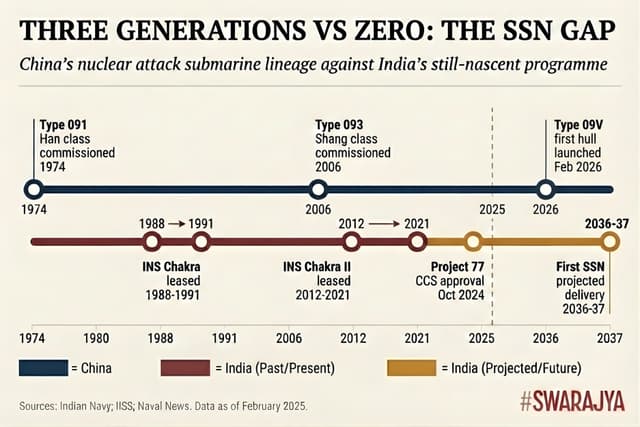
The Type 09V is the third generation of Chinese nuclear attack submarine, following the first-generation Type 091 (Han class, commissioned from 1974) and the second-generation Type 093 (Shang class, from 2006).
The Han class was notoriously noisy, roughly comparable to Soviet submarines of the late 1960s, and only five were built over a painful two-decade span.
The Shang class represented a significant step forward, benefiting from Russian design consultation on hydrodynamics and noise reduction, though early variants were still assessed as significantly louder than their Western contemporaries.
What we know about the Type 09V
Based on available satellite imagery and open-source analysis, the new submarine measures roughly 110 to 115 metres in overall length, not dramatically different from the preceding Type 093 Shang-class boats.
The critical difference is in the beam. At an estimated 12 to 13 metres, the Type 09V is significantly wider than the roughly 9-to-11-metre beams of the Shang family, yielding an estimated submerged displacement of 9,000 to 10,000 tonnes compared to approximately 7,000 tonnes for the Type 093.
The wider hull means substantially more internal volume for reactor systems, combat systems, weapons storage, and noise-dampening measures.
The most visually striking feature is the adoption of X-form stern control surfaces, a first for any Chinese nuclear submarine. X-rudders offer superior manoeuvrability at low speeds and are associated with improved acoustic management, since they reduce flow noise around the control surfaces.
This configuration is already standard on advanced Western submarines, including the latest French and German conventional boats. It was previously seen on a smaller, likely conventionally powered Chinese design, tentatively termed the Zhou class, spotted at Wuchang Shipbuilding in 2024.
An unfinished, open compartment behind the sail is assessed as likely housing a vertical launch system for cruise missiles, similar to the arrangement on the preceding Type 093B. The 093B is believed to carry around 12 to 18 VLS cells for anti-ship and land-attack cruise missiles, including types like the YJ-18 anti-ship missile.
The Type 09V's VLS capacity remains unclear but is expected to be at least comparable.
Propulsion details are obscured in available imagery, but analysts are near-unanimous that the boat uses a pump-jet propulsor rather than a conventional skewback propeller, which is a critical feature for reducing acoustic signatures at speed.
Perhaps most intriguingly, the high waterline visible in imagery, indicated by the exposed red-painted lower hull, suggests reduced reserve buoyancy compared to earlier Chinese submarines. This has led to speculation that the Type 09V may employ a single-hull design, which would be a first for any Chinese submarine.
All previous People's Liberation Army Navy (PLAN) submarines, nuclear and conventional, have used double-hull construction.
A single hull is more space-efficient but demands more sophisticated hydrodynamic shaping, a sign of growing Chinese confidence in hull design and construction quality.
Several characteristics remain unknown, including the torpedo tube arrangement, sonar suite configuration, and reactor specifications.
India is still designing its first SSN
The Type 09V's debut throws India's own nuclear submarine ambitions into sharp relief. While China is now launching its third-generation nuclear attack submarine, India does not yet possess a single SSN. It is still in the early design phase of building one.
This is not for want of trying, or the lack of experience with the construction of nuclear submarines more broadly.
India has been leasing Russian nuclear attack submarines since the late 1980s, when the Soviet Navy provided a Charlie-class SSGN that served as INS Chakra from 1988 to 1991. A second lease, of an Akula-class SSN, ran from 2012 to 2021 as INS Chakra II.
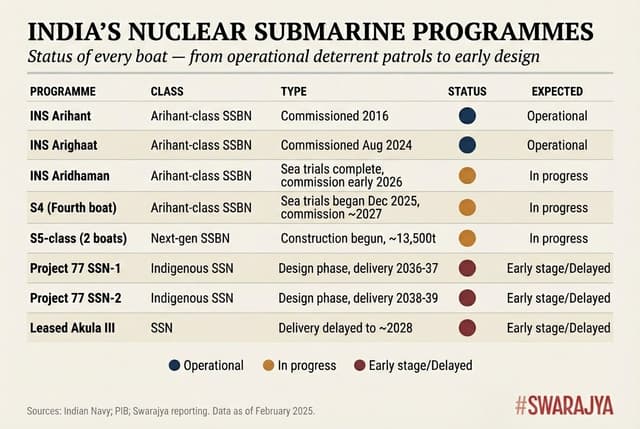
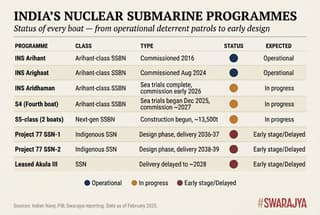
A third Akula-class boat is under a 10-year lease agreement signed in 2019, though delivery has been delayed to approximately 2028.
On the SSBN front, India has made genuine progress.
The Arihant class, developed under the secretive Advanced Technology Vessel (ATV) programme, has delivered real capability. INS Arihant was commissioned in 2016 and INS Arighaat in August 2024. Both are now on deterrent patrols.
The third boat, INS Aridhaman, completed sea trials in late 2025 and is expected to be commissioned in early 2026. A fourth boat began sea trials in December 2025 and should commission by 2027.
Construction has also begun on the next-generation S5-class SSBNs at the Ship Building Centre in Visakhapatnam. These boats will be larger than the ones currently in service, displacing around 13,500 tonnes. They are designed to carry up to 12 long-range SLBMs.
But an SSBN is not an SSN. Ballistic missile submarines exist to hide and, if the worst happens, to retaliate. Attack submarines exist to fight.
India's lack of indigenous SSNs means it cannot provide persistent underwater escort to its growing SSBN fleet, cannot hunt adversary submarines in the Indian Ocean with nuclear-powered endurance, and cannot project conventional undersea power at range.
The indigenous SSN programme, now designated Project 77, received Cabinet Committee on Security (CCS) approval in October 2024 for the construction of two boats at an estimated cost of Rs 40,000 crore.
The programme is being led by the Advanced Technology Vessel headquarters in Visakhapatnam, which also oversees the Arihant-class and S5-class SSBN programmes.
The Navy's Submarine Design Group, part of the Directorate of Naval Design, is responsible for the detailed design, with assistance from the Defence Research and Development Organisation (DRDO).
The Indian Navy has stated it ultimately plans to operate six SSNs. The first of the initial two boats is expected to be delivered by 2036-37, with the second following in 2038-39.
The submarines are anticipated to be powered by a more powerful reactor than the Arihant's 83 MW plant. The Bhabha Atomic Research Centre is developing a 190 to 200 MWe-rated reactor for the purpose. They may also be equipped with DRDO-developed hypersonic missiles and advanced variants of the BrahMos cruise missile.
Even on this optimistic timeline, India's first indigenous SSN will arrive roughly three decades after China commissioned its second-generation Shang class.
China's accelerating submarine production
The launch of the Type 09V comes against the backdrop of what the International Institute for Strategic Studies (IISS) has termed a "boomtime" in Chinese nuclear submarine production, a period in which Beijing has, for the first time, surpassed the United States in both the number and total tonnage of nuclear submarines launched.
Between 2021 and 2025, China launched an estimated 10 nuclear-powered submarine hulls with a combined tonnage of approximately 79,000 tonnes, according to an IISS analysis published in February 2026.
During the same period, the US launched seven hulls totalling roughly 55,500 tonnes. A report submitted to US Congress last month noted that the US Navy is lagging significantly behind its target of producing two Virginia-class attack submarines annually, with American shipyards managing to deliver only about 1.1 to 1.2 boats per year since 2022.


The contrast with the preceding five-year period is stark. Between 2016 and 2020, China launched just two nuclear submarines (23,000 tonnes) against America's seven (55,500 tonnes). In less than a decade, the ratio has effectively reversed.
This acceleration has been enabled by a major expansion of the Bohai shipyard's infrastructure. Between 2019 and 2022, the yard added a second assembly hall, additional fabrication facilities, and supporting infrastructure, effectively doubling its submarine construction capacity.
The yard now features multiple production "slots" capable of accommodating nuclear submarine construction simultaneously, and satellite imagery suggests it may not yet be operating at full capacity.
The IISS assessment notes that China has effectively achieved a "1+2" production output, which translates into one SSBN and two SSN/SSGNs per year. This matches the aspirational target that the US Navy set for itself in a 2023 shipbuilding plan, a target the Americans have struggled to reach.
China's boats are smaller and, by all assessments, less sophisticated than US submarines. US submarines are significantly larger, quieter, and more capable, making them more challenging and time-consuming to build.
But numbers have a strategic logic of their own. A growing fleet of even somewhat less capable submarines can saturate an adversary's anti-submarine warfare capacity, complicate operational planning, and extend China's undersea presence across an ever-wider area.
Meanwhile, in Visakhapatnam and Gurgaon, India’s submarine designers are still refining the blueprints for a nuclear-powered attack submarine that will enter service only in the latter part of the next decade.
Prakhar Gupta (@prakharkgupta) is a senior editor at Swarajya.
 Join our