World
Twelve Years In The Making: The Foreign Policy Doctrine Modi Just Made Public
Venu Gopal Narayanan
Mar 04, 2026, 10:09 AM | Updated 10:09 AM IST
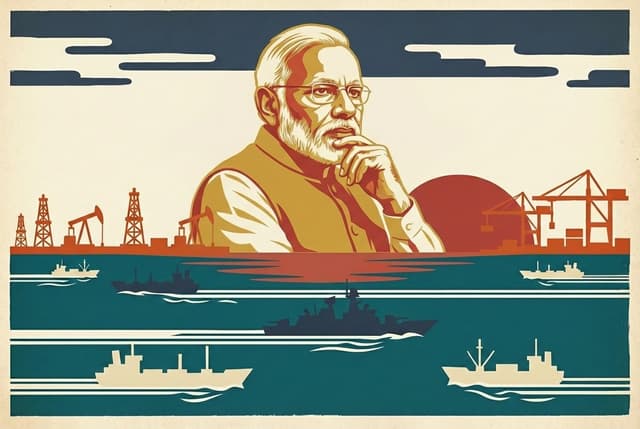
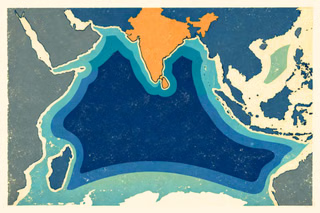
Prime Minister Narendra Modi’s strong, public condemnation of Iranian attacks since 28 February on the United Arab Emirates (UAE), his reference to Emirati President Al Nahyan as ‘my brother’, and his expression of ‘solidarity’ with the UAE marks the first unveiling, at last, of a precise, new foreign policy doctrine for the Indian Ocean Region (IOR). It merits analysis in depth.
A preliminary definition of this doctrine, twelve years in the making, may be posited as thus: India will employ its economic and military strengths, plus a variety of sovereign alliances in the region, to protect and preserve vital common interests of India and its allies, at all cost, by evolving into the net security provider for the IOR with the consent and active cooperation of its allies.
This is a radical departure from the past, where, the insurance of peace (and the periodic triggering of instability) in the Middle East was the sole preserve of America.
Why do we say this?
Iran retaliated to the American-Israeli decapitation strike of its political, theological, and military leadership on 28 February by firing a large number of missiles on almost all the countries in the Middle East for one reason alone – because they housed American military bases.
In the process, it earned the wrath of not just that region, but of many economies around the world as well, because of the resultant disruption of globally-crucial trade into and out of the Persian Gulf.
While none of these countries, all Islamic and one Shia-majority, needed to have their air defence systems tested or their citizenry terrorized, that is precisely what happened for no direct fault of theirs, save, their congenital inability to prevent the establishment of Western military bases on their territories. Not a single country in that region has escaped active, persistent interference in their internal affairs by Western powers, led by America, gallingly, under the guise of ‘guarantors of order’.
Yet, the bald truth is that the region has seen anything but order in the past century. Not a year has passed without confusion, chaos or violence erupting in one or more parts. How many conflicts have broken out, been engineered, or kept on a simmer to stew, wrecking entire societies, simply because that region contains the world’s most reserves of hydrocarbons?
How many efforts at peace between various ethnicities, at various points of time, have been neatly derailed by the powers that be simply because these didn’t suit their interests? Peace is the last thing some entities want in the Middle East.
When China managed the unthinkable in 2023 by brokering a peace deal between Iran and Saudi Arabia, enough analysts immediately predicted that the deal was surely doomed from the start.
They were right. When Israel and the UAE decided to normalise bilateral relations in 2020, it was welcomed by Bahrain, Egypt, Jordan and Oman. But what came of it? Materially, nothing, because any move towards a meaningful peace was unacceptable in certain quarters.
And, when push came to shove, it was these countries which had to suffer Iran’s wrath. You couldn’t but feel for the Saudi official who bluntly stated on a news channel that “America has abandoned us, and focused its defence systems on protecting Israel, leaving the Gulf states that host its military bases at the mercy of Iranian missiles and drones.”
For too long, the West has toyed with the Middle East at its sweet will, whim and rude caprice. This is reminiscent of those famous lines from the Bob Dylan song ‘Masters of war’:
‘You that never done nothin'
But build to destroy
You play with my world
Like it's your little toy’
But the region, including Israel, has had enough. It is now gradually pivoting in parts and phases towards the only major power it can trust – India. This pivot is as much a choice as it is a necessity.
India offers a proximity to the Middle East unmatched by any other large power which the latter might consider as a trustworthy security provider. The two are also umbilically linked at multiple levels be it commerce, investments or the one crore Indians working in the Gulf region.
India’s current rise towards becoming, by far, the third largest market in the world soon, perfectly complements the Middle East’s own long-term plans for a seamless transition away from such utter dependency on hydrocarbons for revenue.
These countries yearn to go beyond a festering Palestine problem which rests as a heavy millstone around their collective neck. That is a sea change from half a century ago when they ruthlessly embargoed the West for supporting Israel in the 1973 war. They want to break free of both the shackles of their past rhetoric, and the powers that presently prevent them from doing so.
One side wants a paradigmatic change while the other seeks to maintain a deleterious, old status quo. And the Middle East cannot do this on its own because it sorely lacks the geopolitical heft to do so. It needs help and guidance, both of which India has begun to actively supply in the past twelve years.
In that sense, this development also reflects India’s political maturation, transitioning away from the Congress party’s traditional, unwieldy, monkey-balancing excuse of a foreign policy that did everything else but strengthen India’s position, security, or profits in the IOR, to a pragmatic, judicious, hard-nosed realist approach. And one of the key elements of this approach, as any international affairs expert will admit, is its hard power; India’s military strength, and its ability to project that force in the region as and when needed for mutual, regional benefit.
No doubt, this is very much still a work in progress, but some of the building blocks are being set in stone: India’s decision to carefully tailor its hydrocarbon offtakes from selected exporters in the Middle East; the decision to stop purchasing crude oil from Iran in 2018-19; a significant increase in Indian companies bagging large infrastructure projects in the Gulf; the expansion of our remarkable digital financial architecture into and across the IOR.
The onus is being placed on countries to recognize the trajectory of India’s growth story, the opportunities that path represents for building fundamental long-term relationships which work, and those countries that do, like Saudi Arabia, the UAE, or Oman, have already started benefiting from their decisions.
Prime Minister Modi’s public declaration of solidarity with the UAE, and India’s silence on the killing of Iran’s spiritual leader, Ayatollah Khamenei, is a significant example of this new doctrine in practice.
If the Iranians chose not to improve relations with India, and instead tried to egregiously interfere in India’s internal affairs at multiple times in the past decade, then they are now the ones without a friend in need, precisely when they needed one. And the price of that choice is the elimination of their leadership.
As a result, for all the missiles being hurled about today, it is doubtful if an escalation of hostilities, a painful jump in oil prices, or the closure of the Persian Gulf to trade, will be allowed to persist for any great length of time. In fact, the interests of both China and India are temporarily aligned on this vital point (not to mention other parts of the world, like Europe, which saw a 20 per cent spike in electricity prices on Monday 2 March).
Yet, even as the Indian political leadership pursues this doctrine, its growing pains will be severe on both India and its partners. Foreign and domestic actors will actively, and aggressively, seek to thwart its implementation.
Already in India, the opposition has launched its own barrage against the government’s silence over Khamenei’s end because its benefits the identity politics they practice.
The West will certainly object, but with each passing year, its ability to do anything material to India, without undermining its own strategic position in Asia, will decline. But they will try, hard, to counter India’s regional rise.
China will not like this either, as it too, is strongly dependent on the IOR for imports and exports. There is little doubt that it will employ its iron brother, Pakistan, to foil this doctrine. Russia and Japan, on the other hand, will welcome this doctrine because a truly stable and secure Middle East is very much in their interests.
Still, it will endure and prevail in the end because, more than anything, it is necessary for Asia. There is a welcome inexorability to this Modi doctrine that heralds a step unto a gradual passing of the colonial era, not least because that is what most countries of the Middle East still actually are – colonies of the West, masked by a veneer of absent sovereignty.
Thus, increasingly, the Indian Ocean Region’s better interests will be met not by the magnanimous sufferance of outsiders, but collectively from within, and led by India.
Venu Gopal Narayanan is an independent upstream petroleum consultant who focuses on energy, geopolitics, current affairs and electoral arithmetic. He tweets at @ideorogue.
 Join our