World
US Is Making Another Bad Bet In Bangladesh At India’s Expense
Prakhar Gupta
Jan 24, 2026, 08:32 PM | Updated Jan 25, 2026, 09:03 AM IST
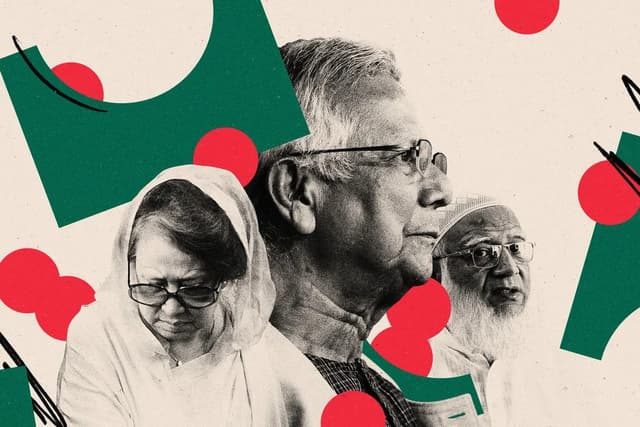
The United States has a new friend in Bangladesh. It is actively courting Bangladesh's most toxic Islamist force, Jamaat-e-Islami, and is doing so with eyes wide open.
This is not a case of American diplomats merely "listening to all sides" or keeping lines of communication open. Washington is actively signalling comfort with Jamaat-e-Islami's rise, talking itself into the belief that the party can be managed, moderated, and bent to US interests once it acquires power. They have brushed aside concerns about its ideological moorings by arguing that the US would have enough economic leverage to keep it in line.
This is not naivety. It is a conscious gamble, and one that comes at India's expense.
Jamaat-e-Islami is not just another conservative political party that happens to use religious language. It is an organisation with a long and ugly history of Islamist extremism, collaboration with Pakistan during the 1971 Liberation War, and hostility towards Bangladesh's foundational idea as a secular republic.
Jamaat's ideological core remains rooted in political Islam and the eventual goal of an Islamic state governed by its interpretation of sharia. Even today, stripped-down talking points about anti-corruption and good governance barely conceal deeply regressive impulses, from curtailing women's participation in the workforce to reordering society along explicitly religious lines. This is the party the United States now believes it can safely mainstream.
To understand how reckless this bet is, one has to rewind to pre-revolution Dhaka, before Sheikh Hasina was toppled and sent into exile. Under Hasina, Bangladesh was no liberal democracy in the Western sense. Elections were deeply flawed, opposition space was constrained, and dissent was often handled with a heavy hand.
But one fact is indisputable. Extremist forces, including Jamaat-e-Islami, were banned, marginalised, and kept firmly under the lid. The state was strong, the rules were clear, and Islamist outfits knew there were red lines they could not cross.
That lid mattered. It allowed Bangladesh to remain relatively stable in one of the world's most volatile regions. It allowed the country to clock high growth rates year after year, build a globally competitive garment industry, lift millions out of poverty, and steadily improve human development indicators.
Hasina also ensured that Bangladesh did not become yet another Islamist flashpoint on India's eastern flank. Whatever her many flaws, Hasina understood one thing with absolute clarity: if you give Islamists oxygen, they will consume the system from within.
Washington, however, decided it did not like Hasina being in power. Instead of dealing with an imperfect but predictable partner, the US chose to shake the hornet's nest. Under the banner of democracy promotion and human rights, it lent moral, diplomatic, and political support to forces that sought regime change in Dhaka.
In doing so, Washington blew the lid off the very box that had contained extremist forces for over a decade. The result was entirely predictable to anyone familiar with Bangladesh's political sociology, and India warned about it repeatedly.
New Delhi reportedly told Washington, again and again, that destabilising Hasina's government would not produce a liberal democratic renaissance. It would unleash Islamist forces that had been waiting patiently on the sidelines. It would embolden Jamaat-e-Islami, re-legitimise its politics, and create serious security risks not just for India but for the entire region.
A Bangladesh drifting towards political Islam would complicate counterterrorism, inflame communal tensions, and add another pressure point in an already fragile neighbourhood.
Those warnings fell on deaf ears. Washington pressed on and aided the forces that ultimately sent Hasina into exile. And exactly as India had cautioned, Jamaat-e-Islami did not just return to the mainstream. It surged.
The Washington Post report itself notes that US diplomats now privately believe Jamaat will deliver its best-ever performance in the February 12 elections. This is not some unforeseen consequence. This is the outcome India said would happen.
What makes the situation truly enraging is not just the original miscalculation, but the smugness with which American diplomats now seem to be processing the wreckage. In private conversations quoted by the Post, a US official described Hasina's conviction as "politically genius", even while admitting the tribunal was not free and fair.
This is breathtaking cynicism, but it is also entirely familiar. To applaud a legally dubious conviction because it neatly removes a geopolitical inconvenience is not a lapse in judgment. It is standard American practice.
Across regions and decades, democratic norms have been invoked as sacred principles when adversaries violate them, and quietly reduced to procedural irritants when they stand in the way of a desired outcome.
The casual admission that the tribunal was not free and fair, followed immediately by praise for its political utility, is not a contradiction. It is not a slip of the tongue or an undiplomatic aside. It is the doctrine laid bare. It is a clear window into how Washington actually views democracy: not as a value to be protected, but as a tool to be switched on or off depending on who is being removed and who is being empowered.
Instead of pausing to reassess, Washington is now doubling down. It believes it can manage the Islamist resurgence it helped unleash. It believes it has leverage. It believes that by dangling access to Western markets and threatening tariffs, it can discipline Jamaat-e-Islami once the party accrues real power. This is delusion dressed up as diplomacy.
Islamist movements do not behave like rational, profit-maximising actors in a Western policy memo. Ideology, not GDP growth, is their organising principle.
Jamaat's own policy signals make this abundantly clear. One of its headline ideas, limiting women's working hours, directly targets the backbone of Bangladesh's economy. The garment and textile sector, which employs millions of women and accounts for roughly 80 per cent of exports, is the engine that keeps the country running. Any serious disruption to women's participation in this sector would be economically catastrophic.
And yet Jamaat continues to float such proposals because it simply does not care about economic orthodoxy as understood in Washington or New York. Its priorities lie elsewhere: in social engineering, moral policing, and ideological consolidation.
The idea that the threat of tariffs or sanctions will suddenly make such actors see reason ignores decades of evidence to the contrary. Economic pain has rarely moderated Islamist behaviour. More often, it is weaponised internally, blamed on foreign conspiracies, and used to justify even harsher policies at home.
The United States is essentially telling itself a comforting story. It believes it can always pull the plug if things go wrong. But geopolitics does not offer easy reset buttons.
Once Islamists gain institutional power, they entrench themselves quickly. They reshape laws, intimidate opponents, and alter the political ecosystem in ways that are extremely difficult to reverse without widespread instability. By the time Washington realises its leverage is overstated, the damage will already be done.
For India, the costs are obvious and immediate. A Jamaat-influenced Bangladesh is not just a domestic issue for Dhaka. It has direct implications for border security, radicalisation, minority safety, and regional stability. India has already designated Jamaat-e-Islami in Kashmir as an unlawful organisation. Seeing the same ideological network empowered next door is a strategic nightmare, one that New Delhi foresaw and tried to prevent.
Yet Washington seems willing to brush aside these concerns, partly because the broader US-India relationship is going through a rough patch. As one analyst quoted in the Post bluntly puts it, if ties were in better shape, the US might have been more sensitive to Indian anxieties. That admission should worry anyone who believes the partnership is built on shared strategic understanding rather than transactional convenience.
The tragedy here is that none of this was inevitable. The US could have pushed for political reforms in Bangladesh without tearing down the one leader capable of keeping Islamists in check. It could have calibrated pressure instead of pursuing maximalist regime change. It could have listened when India, the country that actually lives with the consequences, sounded the alarm.
Instead, Washington chose to gamble. It lost once when its intervention opened the door to Jamaat's resurgence. And now it is making another bad bet by assuming it can control what comes next.
History suggests otherwise. When the delusion crashes, and it will, Bangladesh will pay the price, the region will absorb the shock, and India will be left dealing with the fallout of an American experiment gone wrong.
Prakhar Gupta (@prakharkgupta) is a senior editor at Swarajya.
 Join our